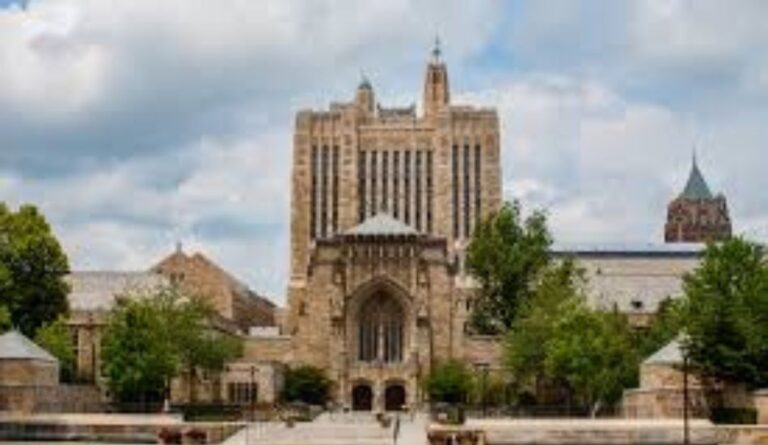

Harkness Tower: Yale’s Iconic Gothic Bell Tower
Rising majestically above Yale University’s campus, Harkness Tower is more than just a landmark — it is a symbol of Yale’s history, tradition, and architectural ambition. With its soaring height, sculpted figures, and carillon bells that chime across New Haven, the tower captures both the spiritual and scholastic spirit of Yale.
Location & Basic Facts
Harkness Tower stands at 74 High Street, New Haven, Connecticut (06510), at the heart of Yale’s Memorial Quadrangle. Construction began in 1917 and was completed in 1921, with the Memorial Quadrangle fully finished by 1922. Designed by James Gamble Rogers in the Collegiate Gothic style, the tower reaches a height of 216 feet (66 meters) and contains nine floors, making it an imposing presence on the Yale skyline.
Historical Background
The tower was commissioned by Anna M. Harkness in memory of her son, Charles William Harkness, who graduated from Yale in 1883 and died in 1916. When Yale’s first residential college system was established in 1933, Harkness Tower became part of Branford College — integrating its grave elegance into student life.
James Gamble Rogers, Yale alumnus and architect, used medieval Gothic precedents as his inspiration. Notably, he looked to the 15th-century St. Botolph’s Church (“Boston Stump”) in Boston, England, for the tower’s overall form, and to St. Giles’ Church in Wrexham, Wales for some of its decorative elements. According to Branford College’s history, the tower’s foundation descends approximately 90 feet to bedrock, providing a strong anchor for the tall masonry structure.
Architecture & Design
Harkness Tower’s design is a masterclass in Collegiate Gothic architecture. Its construction combines New England granite with Ohio brownstone, backed by brick masonry, creating a rich textural effect. From a square base, the tower rises in stages, culminating in an octagonal crown adorned with pinnacles and stone finials.
Inside, a winding stone staircase of 284 steps ascends from street level to the top. Midway up the building are four openwork copper clock faces, arranged around the tower’s shaft.
Sculptural work by Lee Lawrie decorates the tower at multiple levels: at its base, the “Yale worthies” (famous Yale alumni) are carved in stone; higher up are classical philosophers and allegorical figures; the uppermost level features student-themed gargoyles — depicting a writer, a scholar, an athlete, and a socialite — alongside literary icons like Dante and Shakespeare.
Inside the Tower: Bells, Chapel & More
Within Harkness Tower resides the Yale Memorial Carillon, an impressive musical instrument made up of 54 bronze bells. The original 10 bells were installed in 1922, and a later expansion added 44 more in 1966. The console for playing is located just below the bell level, under the clock faces.
The lower levels of the tower include a now-disused water tank, two practice carillon keyboards, the old chimes console, offices for the Yale Guild of Carillonneurs, and a small memorial chapel. The Guild of Carillonneurs is a student group that maintains and performs on the carillon; during the academic year, they play twice daily — at 12:30 p.m. and 5:30 p.m. — while in summer there are evening concerts and a Friday concert series.
Restoration and Preservation
Over time, the tower needed careful restoration. Between 2009 and 2010, a major masonry rehabilitation project was undertaken to repoint stone joints, replace damaged stone, restore stained glass, and upgrade protective systems. Earlier, in 1981, steel reinforcement was added to strengthen the structure, especially after the carillon bells were expanded. The restoration project ensured that both the structural integrity and the architectural beauty of the tower were preserved for future generations.
Tours, Tickets & Visiting Harkness Tower
For those who wish to go inside, Yale offers guided tours of Harkness Tower through its Guild of Carillonneurs. These tours typically include climbing a portion of the 284 steps, seeing the practice carillon keyboards, viewing the bell frame, and hearing a live demonstration. Admission is free, but advance registration is often required — and participants should be aware that the climb is steep.
Symbolism, Myths & Cultural Impact
Harkness Tower holds more than physical height — it carries symbolic weight. When completed, its 216-foot height was deliberately matched to the number of years since Yale’s founding. Over time, myths and lore have surrounded its history. One persistent, though false, story claims that acid was poured down the tower walls to give it an aged look; in truth, structural reinforcements were required later to support the added bells.
Today, the tower is one of Yale’s most beloved symbols. Its image has even been adopted by student publications. Architecturally, it is recognized as the first “couronne” or “crown” tower built in the modern era in English Perpendicular Gothic style.
Why Harkness Tower Matters
Harkness Tower is more than a decorative spire — it’s a focal point of Yale’s architectural identity and memory. Its design integrates memorialization (of Charles Harkness), scholarship (via carved historical and intellectual figures), and musical tradition (through the carillon). It also links Yale physically and symbolically to medieval European universities, especially with its Gothic form and its sculptural iconography.
For visitors, climbing the tower and hearing the bells offers a rare chance to connect with Yale’s living heritage. The carillon performances, sculpted figures, and panoramic views all reinforce why the tower remains an architectural treasure.
Article prepared for Thegoted.com