
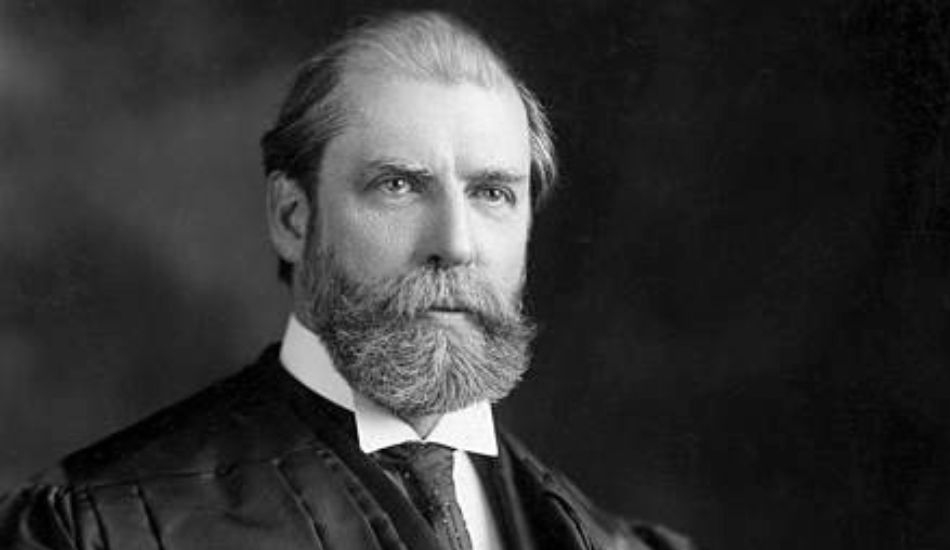
Charles Evans Hughes: Jurist, Statesman, and Republican Presidential Candidate
Charles Evans Hughes stands as one of the most influential figures in American history, renowned for his contributions to law, politics, and public service. His career, spanning over six decades, encompassed roles as Governor of New York, Associate Justice, U.S. Secretary of State, and Chief Justice of the United States Supreme Court. Hughes also made his mark on national politics as the Republican nominee in the 1916 U.S. presidential election, narrowly losing to incumbent President Woodrow Wilson. Through his legal acumen, diplomatic skill, and commitment to public service, Hughes left an indelible legacy that shaped the judicial, political, and diplomatic landscape of the United States.
Early Life and Background
Charles Evans Hughes was born on April 11, 1862, in Glens Falls, New York, to a family with modest means. From an early age, Hughes demonstrated intellectual curiosity and discipline, traits that would define his remarkable career. His parents encouraged a rigorous education, and he excelled academically, showing an early interest in law, governance, and public affairs. Growing up in a post-Civil War America, Hughes witnessed a nation in transition, which influenced his understanding of law, justice, and social responsibility.
Education
Hughes’ academic journey was distinguished by excellence and breadth:
He attended Madison University (now Colgate University) for two years, establishing a strong foundation in liberal arts.
He graduated from Brown University in 1881 with an A.B. degree, demonstrating exceptional scholarly ability.
Pursuing a legal career, Hughes enrolled at Columbia Law School, where he earned his LL.B. in 1884, graduating at the top of his class.
Following graduation, he was admitted to the New York Bar, beginning a legal practice that would later propel him into the national spotlight.
His education combined rigorous legal training with a broad understanding of civic and governmental issues, equipping him for leadership roles in law, politics, and public administration.
Early Legal and Political Career
After completing his legal education, Hughes began practicing law in New York City, quickly gaining recognition for his analytical mind and persuasive advocacy. His reputation grew as he represented clients in complex cases, including utility and insurance investigations that drew public attention.
In 1905, Hughes served as counsel to legislative committees investigating corruption and mismanagement in New York utilities, earning a reputation as a reform-minded attorney dedicated to public accountability.
His growing prominence led to his election as Governor of New York in 1906, serving from 1907 to 1910. As governor, Hughes championed progressive reforms, strengthened civil service regulations, and promoted transparency in government operations. His tenure highlighted his ability to balance political pragmatism with principled leadership.
Supreme Court and Judicial Service
Associate Justice (1910–1916)
In 1910, President William Howard Taft appointed Hughes as an Associate Justice of the U.S. Supreme Court. During this period, Hughes gained a reputation for meticulous reasoning, fairness, and respect for the Constitution. His decisions reflected a careful balance between federal authority and individual rights, establishing him as a leading legal mind of his generation.
Chief Justice (1930–1941)
After years of distinguished service in law, politics, and diplomacy, Hughes was appointed Chief Justice of the United States by President Herbert Hoover in 1930. His tenure on the Court coincided with some of the nation’s most challenging periods, including the Great Depression and the New Deal era.
Hughes navigated complex constitutional questions, often mediating between conservative and liberal factions within the Court.
He played a central role in maintaining judicial independence, particularly during the political pressures of President Franklin D. Roosevelt’s court-packing proposal in 1937.
Hughes retired on June 30, 1941, leaving a legacy of legal prudence, fairness, and institutional stability.
1916 Presidential Election
Hughes resigned from the Supreme Court in 1916 to run as the Republican nominee for President, challenging Woodrow Wilson. The election was one of the closest in American history, with Hughes narrowly losing the electoral vote. Despite the loss, his candidacy demonstrated the high regard in which he was held nationally and underscored his commitment to public service and civic duty.
Secretary of State (1921–1925)
Hughes served as U.S. Secretary of State under Presidents Warren G. Harding and Calvin Coolidge, playing a pivotal role in post-World War I diplomacy.
He advocated for disarmament, international cooperation, and the promotion of American interests abroad.
Hughes participated in significant international negotiations and treaties, helping shape U.S. foreign policy during a period of global instability.
His diplomatic skill reinforced his reputation as a statesman capable of navigating complex international affairs with prudence and foresight.
International Work and Legal Influence
Beyond domestic service, Hughes served as a judge on the Permanent Court of International Justice in The Hague from 1928 to 1930. This role highlighted his commitment to international law, diplomacy, and justice, further establishing his global reputation as a legal and political authority.
Family Life
Charles Evans Hughes married Antoinette Carter in 1888. Together, they had four children, each of whom achieved distinction in various fields:
Charles Evans Hughes Jr., who served as U.S. Solicitor General from 1929 to 1930.
Elizabeth Hughes Gossett, notable as one of the first Americans treated with insulin for type-1 diabetes.
Catherine Hughes Waddell
Helen Hughes
Hughes’ family life reflected his commitment to public service and the nurturing of civic-minded values across generations.
Political Views and Philosophy
Hughes’ political philosophy was characterized by:
A progressive mindset, particularly evident during his governorship and early political career.
Pragmatism and moderation, balancing conservative and liberal perspectives on the Supreme Court.
A belief in judicial independence and the importance of constitutional checks and balances.
Advocacy for ethical governance, transparency, and accountability in both domestic and foreign policy.
His nuanced approach allowed him to navigate periods of intense political and economic turbulence while maintaining respect across party lines.
Quotes and Reflections
Hughes was known for his eloquence and insight:
“When we lose the right to be different, we lose the privilege to be free.”
“Men do not die from overwork. They die from dissipation and worry.”
“The first lesson in civics is that efficient government begins at home.”
“A man has to live with himself, and he should see to it that he always has good company.
These quotes reflect his commitment to ethical leadership, civic responsibility, and personal integrity.
Death and Legacy
Charles Evans Hughes passed away on August 27, 1948, in Osterville, Barnstable, Massachusetts, at the age of 86. His death marked the end of a life devoted to the law, public service, and diplomacy.
His legacy encompasses:
Judicial Leadership: As Chief Justice, Hughes shaped constitutional interpretation and upheld the independence of the judiciary.
Political Impact: His presidential candidacy and political reforms highlighted his commitment to public service.
Diplomatic Contributions: Hughes advanced U.S. foreign policy and international law during a transformative period in world affairs.
Intellectual Influence: Through his decisions, writings, and public service, Hughes left a lasting mark on American legal thought and governance.
Charles Evans Hughes remains a symbol of integrity, wisdom, and dedication to the principles of justice and public service, making him one of the most significant figures in American history.
Article published for: Thegoted.com