George Grosz: Life, Art, Legacy, and the Sharp Eye That Captured a Turbulent Era
George Grosz remains one of the most influential, sharp-eyed, and bold artists of the 20th century. Known for his satirical drawings, biting caricatures, and vivid depictions of social and political chaos, Grosz became an iconic figure across multiple art movements—Expressionism, Dada, New Objectivity, and Modernism. His work not only reflected his time but challenged society with a raw truth that few dared to express.
This detailed article covers who George Grosz was, his age and birthday, education, artistic career, family, paintings, style, and his legacy in modern art.
Who Is George Grosz?
George Grosz was a German-born American artist best known for his unforgiving caricatures of life in post–World War I Berlin. He exposed corruption, moral decay, inequality, and political extremism with a level of brutality and honesty that made him both celebrated and feared.
Born George Ehrenfried Groß on July 26, 1893, in Berlin, he later anglicized his name to “George Grosz” as a symbolic rejection of German nationalism after witnessing the horrors of World War I.
Throughout his life, Grosz remained outspoken, politically charged, and uncompromising. His artworks delivered powerful commentary on capitalist greed, militarism, fascism, and the hypocrisy of the elites.
George Grosz Age and Birthday
Birthday: July 26, 1893
Died: July 6, 1959, in West Berlin
Age at Death: 65 years
Grosz spent his early life during a period of rising industrialization and political tension in Germany. By the time he was a teenager, Europe was already heading toward war, and his experiences shaped the themes that later filled his drawings and paintings.
George Grosz Education
George Grosz began studying art at a young age. His education played a significant role in shaping his artistic voice.
Formal Education
1909–1911: Studied at the Dresden Academy of Fine Arts
1912–1916: Continued his art studies at the Berlin College of Arts and Crafts
During his time in Berlin, Grosz was exposed to a lively art scene filled with radical thinkers, anarchists, Dadaists, and political dissidents. This environment fueled his interest in satire, criticism, and artistic rebellion.
George Grosz Career Overview
Grosz’s career can be divided into several major phases, each connected to major political and social changes in the world around him.
Early Career & World War I Influence
Grosz was drafted into the German Army during WWI but was released due to illness. His time in uniform, however brief, showed him the brutality and meaninglessness of war. This fueled his anti-militaristic stance, which became a central theme in his work.
He began producing harsh drawings attacking the military establishment, political corruption, and the social systems failing ordinary German citizens.
George Grosz and the Dada Movement
Around 1917–1920, Grosz became active in the Berlin Dada movement, working alongside artists like John Heartfield and Raoul Hausmann.
Berlin Dada was far more political than its Zurich counterpart. Grosz’s Dada works included:
Chaotic collages
Anti-war posters
Satirical drawings targeting nationalism
Brutally honest portrayals of life in Berlin
His Dada contributions established him as a leading political artist.
New Objectivity (Neue Sachlichkeit) Period
In the 1920s, Grosz became associated with the New Objectivity movement, which rejected Expressionism in favor of realism, precision, and critical social commentary.
His artworks from this period include famous drawings and paintings of:
Corrupt politicians
Prostitutes
War veterans
Drunken bourgeois men
Street violence
Rising fascism
Among his most iconic works is “The Eclipse of the Sun” (1926), a political masterpiece showing the dangers of blind nationalism.
Notable George Grosz Paintings
Some of his most influential works include:
“The Eclipse of the Sun” (1926)
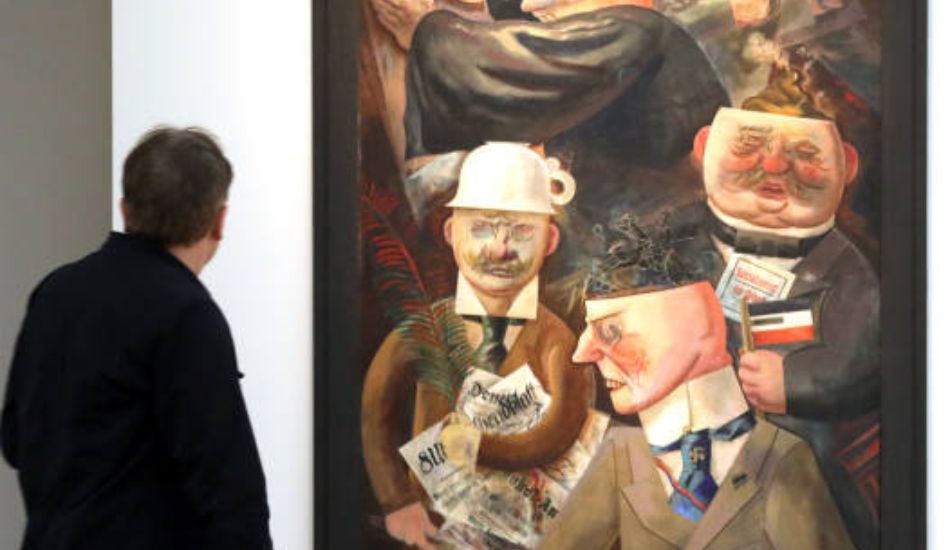
“Pillars of Society” (1926)
“The Funeral” (1917–1918)
“Metropolis” (1916–1917)
“Republican Automatons” (1920)
“After the Storm” (one of his famous political compositions)
Each one critically portrays the instability and corruption of Weimar Germany, making Grosz one of the clearest voices of social truth in his era.
George Grosz in the United States
With the rise of Nazism in Germany, Grosz’s anti-fascist art made him a target. In 1933, shortly before Hitler rose to full power, Grosz moved to the United States.
Life in America
Became a U.S. citizen in 1937
Worked as a teacher at the Art Students League in New York
Created new works, though less politically charged
Wrote his autobiography “A Little Yes and a Big No”
Although he softened his approach in the U.S., he remained respected as a major European modernist.
George Grosz Art Style
Grosz’s style evolved through several art movements, but several characteristics remained consistent:
1. Satire and Caricature
He exaggerated facial features and body shapes to expose the ugliness of greed, arrogance, and corruption.
2. Sharp Lines & Bold Outlines
His drawings often used aggressive, almost violent lines, symbolizing chaos and instability.
3. Urban Realism
Grosz captured the nightlife, crime, and poverty of Berlin with shocking accuracy.
4. Political Commentary
His art was a protest—against war, capitalism, fascism, and social hypocrisy.
George Grosz Assassination Claim
There is a long-running myth surrounding Grosz’s death, with some sources claiming he died due to political retaliation. However, historical records indicate that Grosz died after falling down a flight of stairs in his Berlin apartment on July 6, 1959.
There is no verified evidence supporting claims of assassination, although Grosz himself remained controversial and politically outspoken until the end of his life.
George Grosz Drawings and Cartoons
His drawings and cartoons were key to his influence. They appeared in magazines, posters, books, and satirical publications.
Famous cartoon themes:
Immoral businessmen
Military officers drunk with power
Corrupt politicians
Prostitutes and nightlife
Social inequality
Post-war trauma
These sharp illustrations made Grosz one of the leading political cartoonists of his generation.
George Grosz: Family Background
Parents
Father: Karl Ehrenfried Grosz
Mother: Marie Wilhelmine Luise Grosz
His father died when he was still young, and his mother’s struggles to support the family exposed him early to poverty and social injustice.
George Grosz Wife
Grosz married Eva Louise Peter in 1920, and they remained married until his death in 1959. Eva was supportive throughout his turbulent artistic life, accompanying him during his move to the United States and back to Berlin.
George Grosz Children
George and Eva had three children:
Marty Grosz – jazz guitarist and composer
Peter Michael Grosz – died young
Peter Grosz – writer and painter
His children inherited artistic and creative passions, especially Marty, who became a well-known jazz musician.
The Legacy of George Grosz
George Grosz’s impact on art and social criticism remains immense. His brutal honesty, sharp caricature style, and willingness to confront political extremism made him one of the most important artistic voices of the 20th century.
Today, his works are held in major museums worldwide, and his influence can be seen in political cartoons, modern social commentary art, and contemporary satirical illustration.
His art remains a reminder of the dangers of totalitarianism, corruption, and blind nationalism—issues that continue to resonate globally.
Conclusion (Mentioning Your Blog)
George Grosz was not just a painter but a truth-teller who used art as a weapon against injustice. His fearless depictions of the world around him, from corrupt politicians to suffering civilians, capture the spirit of a troubled era with unmatched clarity. His influence spans Dada, Expressionism, Modernism, and New Objectivity, making him one of the most significant artists of his generation.
For more deep-dive biographies and artistic history articles, visit Thegoted.com.